

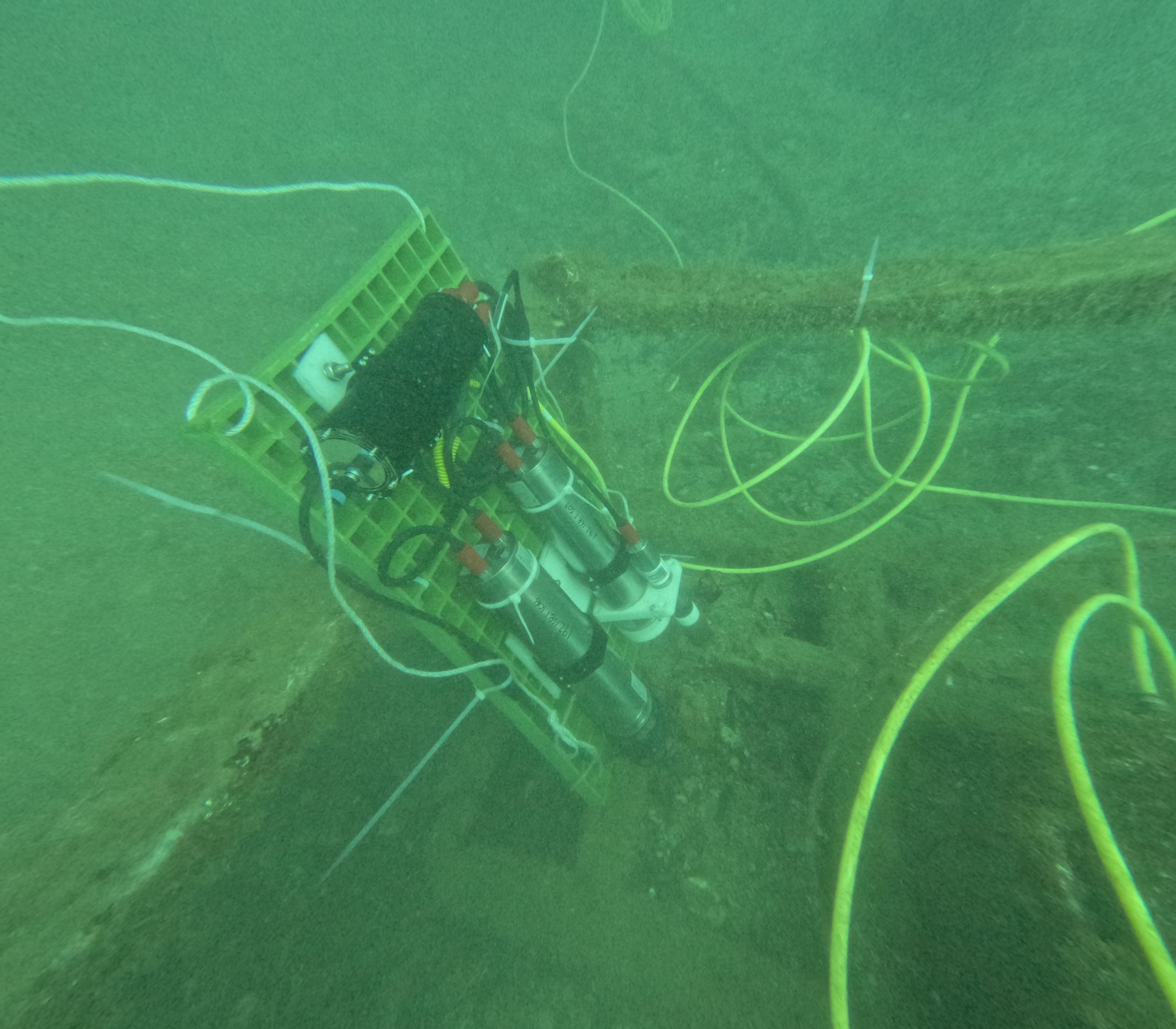
As part of the GEORGE project, a new generation HydroC CO₂ sensor equipped with an innovative thruster-based antifouling system has been successfully deployed at the OBSEA Observatory coastal cabled observatory in the Northwestern Mediterranean Sea.
The deployment took place in April 2026 at approximately 20 m depth and is currently ongoing as a multi-month operational validation under real coastal conditions. The activity supports GEORGE Task 2.5, focused on developing advanced antifouling solutions for long-term marine biogeochemical observations.
The deployed system integrates a submersible HydroC CO₂ sensor developed by GEORGE partner -4H-JENA engineering GmbH with a novel thruster-based water circulation mechanism designed to reduce biofouling and improve long-term operational reliability. Unlike conventional pump-based configurations, the thruster continuously supplies fresh seawater to the sensor head and periodically reverses its rotation to clean the external copper mesh and prevent clogging.
Prior to deployment, the integrated system underwent laboratory validation and hyperbaric testing. Installation at OBSEA was carried out by scientific divers using the observatory’s cabled infrastructure, enabling continuous power supply and real-time data transmission to shore. During the preparation phase, additional infrastructure adaptations were implemented at OBSEA to provide sufficient power availability for the antifouling system.
The deployment aims to evaluate:
• Long-term stability of pCO₂ measurements
• Resistance to biofouling in shallow coastal environments
• Mechanical reliability of the thruster-based antifouling solution
• Operational compatibility with EMSO cabled observatory infrastructures
Data acquisition started immediately after deployment and is currently ongoing. Measurements are integrated into the OBSEA data infrastructure and are accessible through ERDDAP services and real-time Grafana dashboards, supporting continuous operational monitoring and future scientific exploitation.
This deployment represents an important step toward improving the robustness and operational maturity of long-term autonomous carbon observation technologies within European marine research infrastructures. According to the GEORGE assessment, the successful operational deployment at OBSEA demonstrates progression of the system toward Technology Readiness Level (TRL) 7, with continued long-term operation expected to support advancement toward TRL 8.