

An upcoming deployment at the PLOCAN test site in the Canary Islandsis demonstrating how underwater sensors, autonomous vehicles, and communication systems can work together as a connected network. Using innovative Internet of Underwater Things (IoUT) technology, GEORGE partners PLOCAN, WSense and ClearWaterSensors are taking a key step towards real-time ocean data transmission.
Data transmission remains one of the major challenges for underwater observations. While data is typically collected using cabled platforms or periodic sampling operations, these approaches are often insufficient for autonomous measurements carried out in remote locations far from shore.
“With the rise of autonomous platforms, such as gliders, floats, and surface and underwater vehicles, we need efficient systems that enable more communication from these platforms,” says Alejandro Rueda, Project Manager for autonomous systems at PLOCAN, Oceanic Platform of the Canary Islands. “These systems need to be compact, low-power, and capable of handling large volumes of data.”
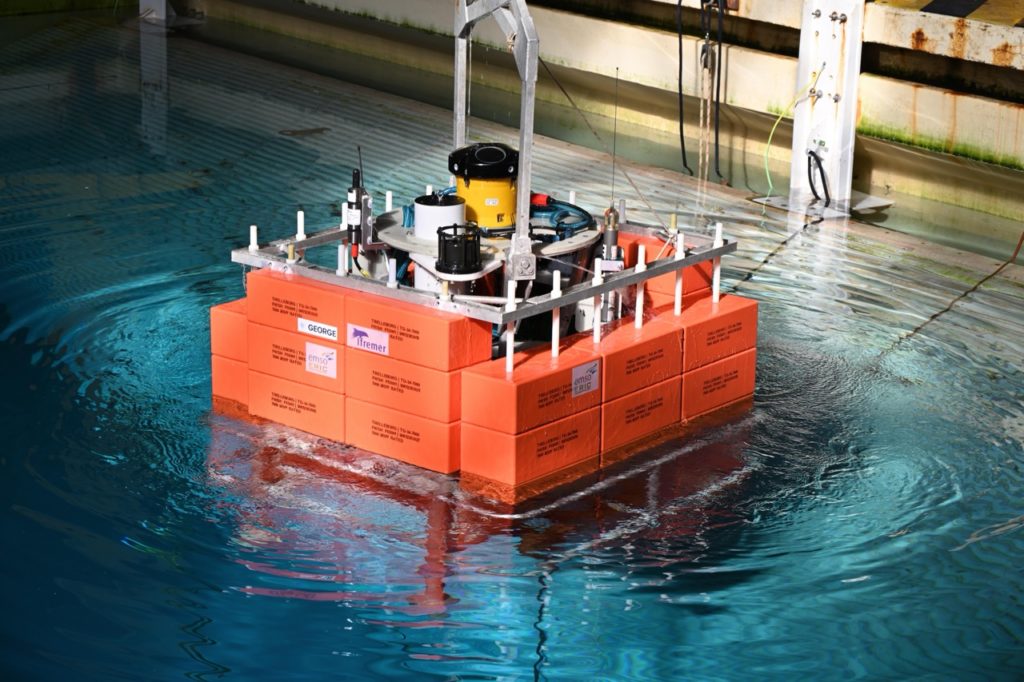
To address this challenge, an underwater acoustic communication network will be deployed at the PLOCAN test site in the Canary Islands. The system uses Internet of Underwater Things (IoUT) technology developed by GEORGE partner WSense, enabling communication between sensors and platforms underwater and supporting real-time data transmission to surface and shore-based cloud infrastructure.
A connected underwater network
The IoUT technology developed by WSense provides the infrastructure for the deployment. It is based on a network of interconnected nodes (WNodes) distributed across the PLOCAN test facility.
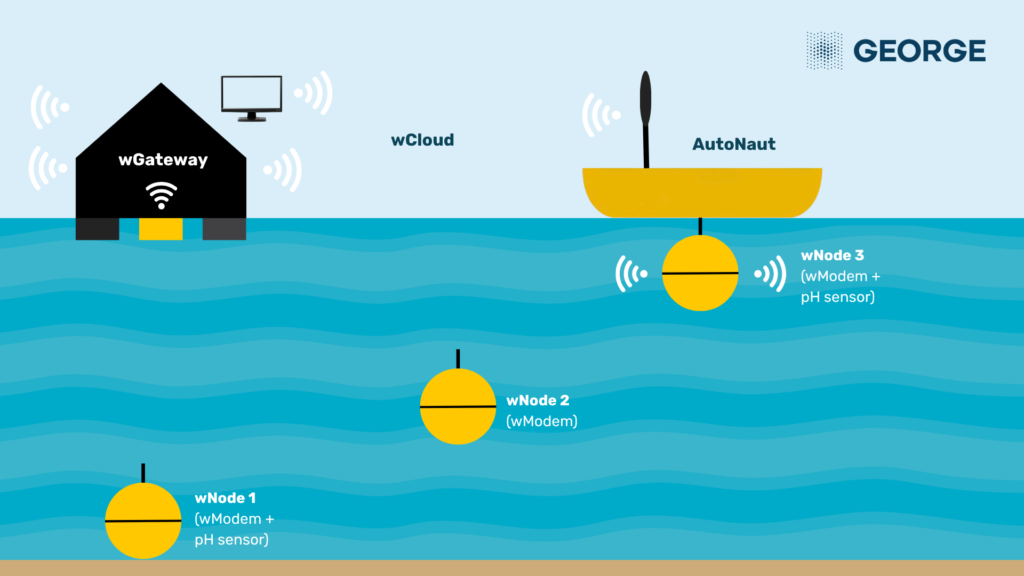
At the centre of the system is a gateway (WGateway) installed on the PLOCAN offshore platform. This gateway connects the underwater network to a cloud service (WCloud), where data can be stored and analysed.
On the seafloor, two underwater WNodes are deployed. One of these nodes is integrated with a lab-on-chip fast pH sensor developed by ClearWaterSensors, which measures key ocean carbon parameters. The second node acts as a relay, forwarding data from the seafloor to the gateway.
In addition, a surface autonomous vehicle Autonaut is equipped with its own pH sensor and communication WNode. This mobile platform can both relay data from the seafloor and transmit its own measurements directly to the gateway when within range.
The system is designed so that communication distances between nodes remain within approximately 500 metres, ensuring reliable acoustic transmission.
“The integration between static and mobile Internet of Underwater Things guarantees continuous real-time punctual and spatial data collection, otherwise not possible with current methodologies”, says Michele Nati, Director of Research and Innovation Projects at WSense SRL.
Testing in real-world conditions
The deployment will take place at the PLOCAN test site, located off the coast of the Canary Islands. The site offers a unique environment for testing, combining controlled conditions with real-world ocean variability. PLOCAN is part of ICOS Spain and a Spanish representing entity for EMSO ERIC.
“The site is located in coastal waters, around 1.5 kilometres from shore,” explains Rueda. “This makes it ideal for testing, because it’s far enough from the coast to reduce noise, but still close enough to allow controlled, real-world conditions.”
The deployment is expected to begin in early April and may last between three and sixteen weeks, depending on environmental conditions.
For the team, success is not only about testing individual components but demonstrating that the entire system can operate reliably over time.
“Success for this deployment would mean achieving reliable, long-term measurements of ocean carbon variables, together with stable underwater data transmission between the underwater and surface systems,” says Alejandro Rueda. “We want to demonstrate that these technologies are ready for operational use.”
Follow GEORGE on LinkedIn, BlueSky and X to stay updated!