

Acoustic sensors are valuable tools for observing wind and rain at sea, two key drivers of exchanges between the ocean and atmosphere. While passive acoustic methods have been used from moored and mobile platforms, their integration on autonomous profiling floats has been limited. Recent work by several partners within the GEORGE and TRICUSO projects has now achieved an important milestone.
As part of the GEORGE project, NKE Instrumentation, in collaboration with the Laboratoire d’Océanographie de Villefranche, has integrated a compact passive acoustic sensor into a PROVOR CTS5 BGC-ARGO profiler. This sensor named “met-PAL” was previously developed by NKE Instrumentation in partnership with ABYSsens. It records underwater sound created by wind and waves at the surface, allowing wind speed to be estimated from depths between 500 and 1000 meters.
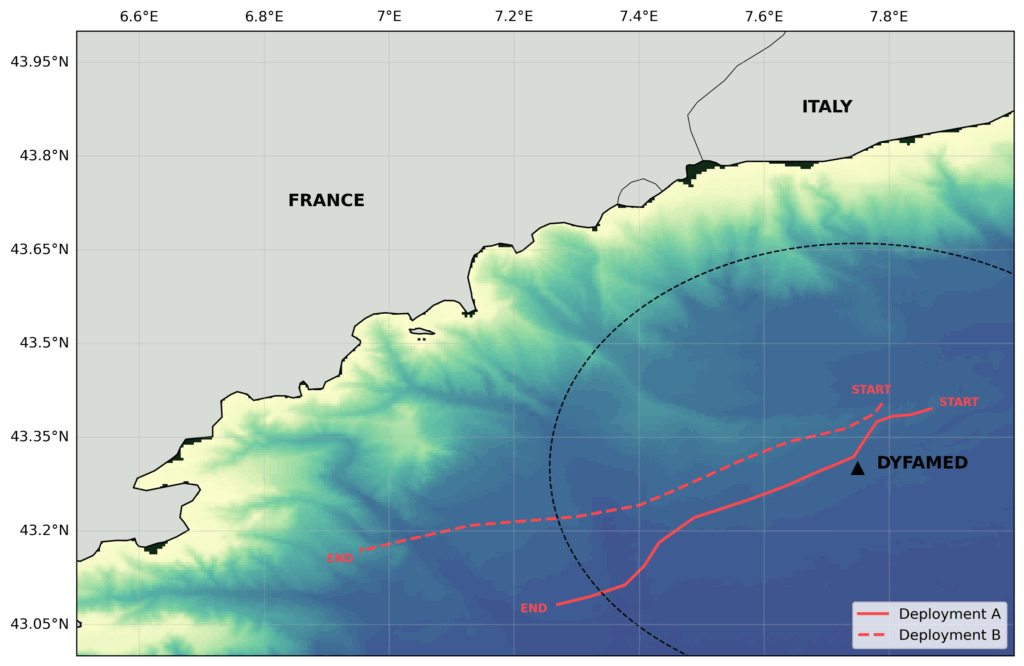
A prototype float equipped with a met-PAL sensor has been deployed twice by LOV in the northwestern Mediterranean Sea between February and April 2025, close to the “Côte d’Azur” meteorological buoy (Meteo-France) located at the DYFAMED site integrated in the national program MOOSE (Mediterranean Ocean Observing System for the Environment) funded by CNRS-INSU.
Results from this trial, now available as a preprint (Delaigue et al., 2025), show that wind speeds derived from the float’s acoustic data matched those recorded by the DYFAMED buoy. The team also demonstrated that combining acoustic data with ERA5 atmospheric reanalysis allows wind speed to be estimated even when the float is far from direct surface observations.
“We wanted to see if it was actually possible to hear the wind from underwater,” said Dr Louise Delaigue, lead author of the study. “It sounds a bit strange, but the float can really detect surface wind conditions just by recording ambient noise at depth. The first deployment showed that the relationship is very clear once you process the data properly.”
“We deployed the float near DYFAMED because it’s a really well-instrumented site,” she explained. “It allowed us to compare our underwater acoustic estimates with the buoy’s surface wind data, which was essential to show that the method actually works.”
A new deployment is planned in Italy in 2025, in collaboration with CNR-IAS, to test the system under different ocean and weather conditions.
“We’ll be testing slightly different configurations and reference datasets to see how robust the approach is in another environments, “ Delaigue describes.
Improving measurement capacities in the Southern Ocean
The study represents an important proof of concept for integrating acoustic sensors with biogeochemical observations on autonomous platforms. This is particularly valuable for quantifying air–sea carbon fluxes in areas such as the Southern Ocean, where direct measurements are scarce. The work links directly to the TRICUSO project, which aims to improve CO₂ flux estimates in the Southern Ocean using, among others, GEORGE-developed technologies.
“This project brought together such a good mix of people,” said Delaigue. “We had sensor engineers, acousticians and oceanographers all working together. I’ve learned so much from the acoustic community. It’s been really supportive and collaborative.”
These developments show how technologies developed in GEORGE are feeding directly into broader European efforts to advance autonomous ocean observing. As more acoustic-equipped floats are deployed, they will help improve understanding of air–sea processes and provide new data for improving global atmospheric and climate models.
Read the article by Delaigue et al 2025 (preprint): https://egusphere.copernicus.org/preprints/2025/egusphere-2025-4174/#discussion